

| CAT Code | Product | Size | Price |
|---|---|---|---|
| PB20.65-01 | Clara® Probe Purple Mix Lo-ROX | 200 x 20 μL Reactions | Contact us |
| PB20.65-03 | Clara® Probe Purple Mix Lo-ROX | 600 x 20 μL Reactions | Contact us |
| PB20.65-05 | Clara® Probe Purple Mix Lo-ROX | 1000 x 20 μL Reactions (5 x 1 mL) | Contact us |
| PB20.65-50 | Clara® Probe Purple Mix Lo-ROX | 10 000 x 20 μL Reactions (1 x 50 mL) | Contact us |
| PB20.66-01 | Clara® Probe Purple Mix Hi-ROX | 200 x 20 μL Reactions | Contact us |
| PB20.66-03 | Clara® Probe Purple Mix Hi-ROX | 600 x 20 μL Reactions | Contact us |
| PB20.66-05 | Clara® Probe Purple Mix Hi-ROX | 1000 x 20 μL Reactions (5 x 1 mL) | Contact us |
| PB20.66-50 | Clara® Probe Purple Mix Hi-ROX | 10 000 x 20 μL Reactions (1 x 50 mL) | Contact us |
| PB20.67-01 | Clara® Probe Purple Mix No-ROX | 200 x 20 μL Reactions | Contact us |
| PB20.67-03 | Clara® Probe Purple Mix No-ROX | 600 x 20 μL Reactions | Contact us |
| PB20.67-05 | Clara® Probe Purple Mix No-ROX | 1000 x 20 μL Reactions (5 x 1 mL) | Contact us |
| PB20.67-50 | Clara® Probe Purple Mix No-ROX | 10 000 x 20 μL Reactions (1 x 50 mL) | Contact us |
| PB20.68-01 | Clara® Probe Purple Mix Separate-ROX | 200 x 20 μL Reactions | Contact us |
| PB20.68-03 | Clara® Probe Purple Mix Separate-ROX | 600 x 20 μL Reactions | Contact us |
| PB20.68-05 | Clara® Probe Purple Mix Separate-ROX | 1000 x 20 μL Reactions (5 x 1 mL) | Contact us |
To view your pricing, please log in or register with your quote code.
Additional Information
Easy-to-Observe Purple Dye
Clara® Probe Purple Mix combines the speed, sensitivity, and specificity of the Clara® reagent line with a non-reactive purple dye for easy sample observation. This dye has significantly reduced the decline of sensing fluorophores, to ensure accurate qPCR results, while minimizing handling and pipetting
The decline in the fluorescence intensity of sensors in Clara® Probe Purple Mixes:
FAM: up to 25%
HEX: up to 30%
Tex: up to 25%
Cy5: up to 10%
The percentages represent the plateau height decline (Purple mix vs. basic mix) in at least two different reactions.
Reliable Probe-based qPCR
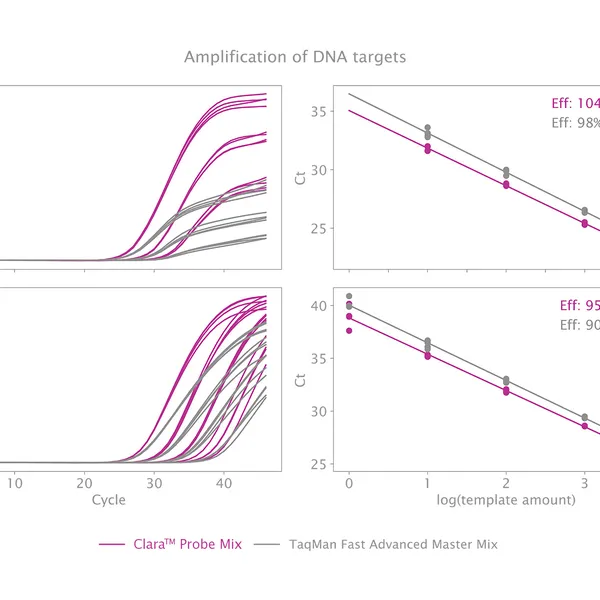
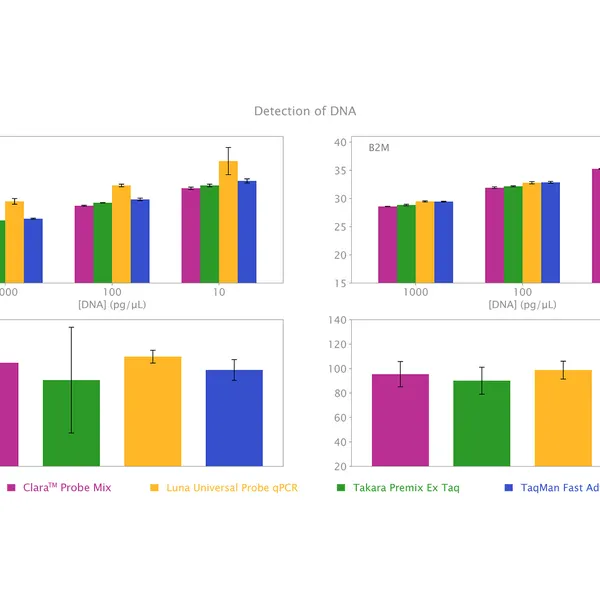
Clara® Probe Mix is designed to perform qPCR with the highest sensitivity, reliability, and ease of use for diagnostic and basic research applications. It is a universal qPCR mix suitable for all probe types, including TaqMan, Scorpions, and molecular beacons. Powered by our proprietary hot-start Taq DNA polymerase enzyme, the qPCR mix is suitable for detecting DNA for 2-step RT-qPCR processes when used with separate cDNA synthesis kits. While for routine RNA quantification, we recommend using 1-step processes with Clara® Probe 1-Step Mix for a smoother workflow.
Clara® Probe Mix can be used for all probe-based qPCR applications, including gene expression analysis, SNP/allele detection, genotyping and allele discrimination studies, species abundance quantification, and is highly effective in both single and multiplex assays. This makes the mix very versatile and ideal for developing in-vitro diagnostic kits and basic research.
This mix is also suitable for melt curve analysis (only with hybridization probes) and is available without passive reference dye (No-ROX), or with reference dye as Lo-ROX, Hi-ROX, and separate-ROX preparations. Use our qPCR Selection Tool to find out which ROX variant is compatible with your device.
Need help with probe-based qPCR experiment design?
Ensure careful design of primers and probes. For efficient amplification in fast cycle conditions, we recommend amplicon lengths between 80 bp to 200 bp. With all types of mixes from manufacturers, shorter amplicon lengths can be cycled faster. Amplicon lengths should not exceed 400 bp. Primers should have a predicted melting temperature around 60 °C, using the default settings of Primer 3 (https://bioinfo.ut.ee/primer3/). For TaqMan probes, choose a probe close to the 5’ primer, avoiding the final guanosine base. Ensure ideal dye and quencher combinations, especially in multiplex reactions.
For more information on designing qPCR experiments and analyzing qPCR results, please refer to our technical guide.
Applications
- 2-step RT-qPCR
- Quantifying species abundance
- Genotyping
- Allele discrimination
- In vitro diagnostic kit development
- Single and multiplex DNA detection
Technical Specifications
Clara® Probe Purple Mix Lo-ROX
| Component | 200 reactions | 600 reactions | 1000 reactions | 10 000 reactions |
|---|---|---|---|---|
| 4x Clara Probe Purple Mix Lo-ROX | 1 x 1 mL | 3 x 1 mL | 5 x 1 mL | 1 x 50 mL |
Clara® Probe Purple Mix Hi-ROX
| Component | 200 reactions | 600 reactions | 1000 reactions | 10 000 reactions |
|---|---|---|---|---|
| 4x Clara Probe Purple Mix Hi-ROX | 1 x 1 mL | 3 x 1 mL | 5 x 1 mL | 1 x 50 mL |
Clara® Probe Purple Mix No-ROX
| Component | 200 reactions | 600 reactions | 1000 reactions | 10 000 reactions |
|---|---|---|---|---|
| 4x Clara Probe Purple Mix No-ROX | 1 x 1 mL | 3 x 1 mL | 5 x 1 mL | 1 x 50 mL |
Clara® Probe Purple Mix Separate-ROX
| Component | 200 reactions | 600 reactions | 1000 reactions | |
|---|---|---|---|---|
| 4x Clara Probe Purple Mix No-ROX | 1 x 1 mL | 3 x 1 mL | 5 x 1 mL | |
| 50 μΜ ROX Additive | 1 x 200 μL | 1 x 200 μL | 1 x 200 μL |
Reaction Information
| Reaction Volume | Storage | |||
|---|---|---|---|---|
| 20 μL | On receipt, products should be stored between -30 and -20 °C. If stored correctly, the kit will retain full activity until the specified expiration date. |
Device Compatibility
This product is compatible with all standard and fast qPCR equipment. Use our qPCR Selection Tool to determine which ROX variant is compatible with your device.
Documents
Product Brochure

Manual
Frequently Asked Questions (FAQs)
Can products generated with Clara® and Clara® Purple mixes be digested, cloned, and sequenced?
Yes, PCR products generated with these mixes have the same characteristics as PCR products generated with wild-type Taq polymerase. They can be sequenced or digested with restriction endonucleases following standard protocols. Products have 3′-d(A) overhang and can be used for TA cloning or can be blunt-ended or digested with restriction enzymes prior to cloning. For best results, we recommend purifying PCR products using any standard PCR cleanup kit.
Do Clara® Probe Mix and Clara® Probe 1-Step Mix contain FAM dye?
No. Apart from ROX (if included in the kit), there are no other dyes in our mixes. Therefore, you can use any fluorophore-linked probe for your reaction.
Is it normal if the fluorescence of Clara® Probe Mix and Clara® Probe 1-Step Mix is different from a competitor's product?
Different products may result in different fluorescence levels. However, this does not affect the accuracy of quantification, and Ct values will not differ between products.
Is storing sample DNA in 1x TE buffer (10 mM Tris-HCl / 1 mM EDTA) compatible with later qPCR using Clara® Probe Mix and Clara® Probe 1-Step Mix?
Yes, this storage buffer is compatible. EDTA will chelate some magnesium in the mix, but not significantly enough to affect the reaction.
What is the ROX concentration in Clara® Probe Mix, Clara® Probe 1-Step Mix, and their corresponding purple mixes?
The Clara® Probe Purple and Clara® Probe 1-Step Purple mixes contain passive reference dyes in multiple formulations, each with different reference dye concentrations:
Lo-ROX mixes (PB20.65 and PB25.85) contain 200 nM ROX.
Hi-ROX mixes (PB20.66 and PB25.86) contain 2 µM ROX.
No-ROX mixes (PB20.67 and PB25.87) do not contain ROX.
The Separate-ROX mixes (PB20.68 and PB25.88) include a separate 50 µM ROX tube. This allows you to choose the ROX concentration you wish to use.
You can use our qPCR selection tool in the resource dropdown menu to determine which of our mixes is best for your qPCR machine.
What troubleshooting options are there if non-specific products appear in my qPCR?
There are various options to consider when optimizing your reaction:
- Reduce the annealing/extension temperature to 5 seconds
- Increase the annealing/extension temperature from 60 to 65°C
Dilute sample DNA by starting with 5ng DNA and using a 10x dilution series. Besides running these on a gel to see if non-specific products persist, the performance of the reaction can be calculated by the qPCR equipment software after performing the sample dilutions. If the performance is between 90 – 110%, then the amplicon is doubling each cycle.
View more