

| CAT No. | Product | Size | Price |
|---|---|---|---|
| PB40.40-05 | PCR Water | 5 mL (1 x 5 mL) | Contact us |
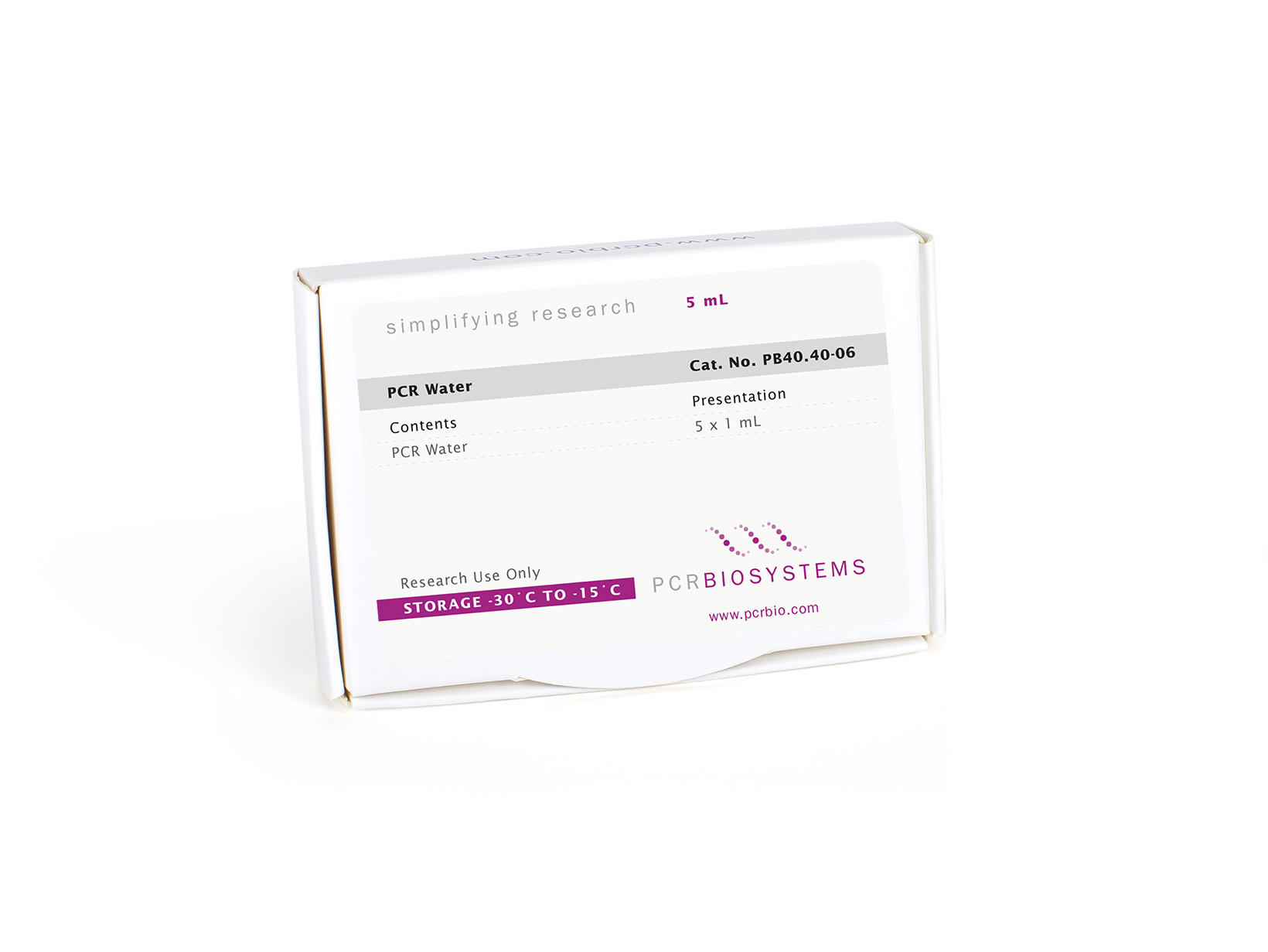
| PB40.40-06 | PCR Water | 5 mL (5 x 1 mL) | Contact us |
| PB40.40-50 | PCR Water | 50 mL (1 x 50 mL) | Contact us |
| PB40.40-51 | PCR Water | 50 mL (50 x 1 mL) | Contact us |
To view your pricing, please log in or register with your quotation reference.
Additional Information
PCR Water can be used as a reaction component with all PCR Biosystems reagents and all other manufacturers' products where the corresponding instructions or documentation call for the use of PCR grade or ultra-pure water.
Furthermore, this product undergoes rigorous testing to ensure maximum reassurance when setting up molecular biology reactions. The activity of DNase, RNase, and protease, as well as DNA, are all below the detection threshold of our stringent assays.
Product packaging sizes are available in small (5 mL) and large (50 mL) volumes, and in both aliquoted form (5 x 1 mL and 50 x 1 mL) or single bottle (1 x 5 mL and 1 x 50 mL), maximizing convenience based on your workflow and throughput requirements.
Nuclease-free water is provided as a more economical alternative that can be used for working with proteins, or other molecular applications where contaminating nucleic acids are not a concern. This product can be used in PCR reactions. However, there is a small possibility that the reactions may be impacted by trace DNA.
Why should you use PCR Water in your molecular biology workflow?
Using ultra-pure deionized water in PCR workflows offers several significant benefits, primarily eliminating the risk of contamination that can adversely affect the sensitivity and accuracy of PCR reactions. In PCR, even trace levels of impurities such as ions, organic compounds, or microbial contamination can lead to non-specific amplification or inhibition of polymerase enzymes, thereby minimizing the accuracy and reliability of results. The ultra-pure deionized water has undergone rigorous purification processes to remove these impurities, ensuring high consistency and reproducibility in PCR assays. It provides a stable and controlled environment, enhancing the efficiency of DNA polymerase, facilitating accurate amplification of target sequences. This level of purity is particularly critical in applications requiring high sensitivity, such as quantitative PCR (qPCR) and diagnostic tests, where the integrity of the results directly impacts research outcomes and patient care.
Applications
- PCR
- qPCR
- All Molecular Biology Reactions
- Sample Dilution
- Use as a Negative Control
Technical Specifications
PCR Water
| Component | 5 mL | 5 mL | 50 mL | 50 mL |
|---|---|---|---|---|
| PCR Water | 1 x 5 mL | 5 x 1 mL | 1 x 50 mL | 50 x 1 mL |
Nuclease-Free Water
| Component | 100 mL | 500 mL | ||
|---|---|---|---|---|
| Nuclease-Free Water | 1 x 100 mL | 1 x 500 mL |
PCR Water
| Component | 5 mL | 5 mL | 50 mL | 50 mL |
|---|---|---|---|---|
| PCR Water | 1 x 5 mL | 5 x 1 mL | 1 x 50 mL | 50 x 1 mL |
Nuclease-Free Water
| Component | 100 mL | 500 mL | ||
|---|---|---|---|---|
| Nuclease-Free Water | 1 x 100 mL | 1 x 500 mL |
Reaction Information
| Reaction Volume | Storage | |||
|---|---|---|---|---|
| Not applicable | Upon receipt, the product can be stored at room temperature. Once opened, care should be taken to avoid contamination and storage at -30 to -20 °C is recommended. The product can be stored indefinitely before first use. |
Documents

Safety Data Sheet
Frequently Asked Questions (FAQs)
Can I dilute my samples with PCR Water?
Yes. In fact, using PCR Water when preparing and diluting molecular biology samples is highly recommended. This minimizes the risk of contamination for the samples themselves and also ensures that ion content is minimized, thereby reducing potential interference with enzymatic reactions.
Can I use PCR Water for other molecular biology assays besides PCR?
PCR Water from PCR Biosystems can be used with all common molecular biology derivatives, regardless of manufacturer or type of application, where the respective manuals or instructions call for molecular biology, PCR-grade, or ultra-pure water.
What does DNase, RNase and protease-free mean in relation to PCR Water?
This means that the activity of DNase, RNase, and protease is below the detection limits of our stringent quality control assays. The product is guaranteed free from these enzymatic activities, by this definition, prior to first use. Once opened, care should be taken to avoid contamination, especially if the same aliquot will be stored after first opening.
Read more