

| MS CAT | Product | Size | Price |
|---|---|---|---|
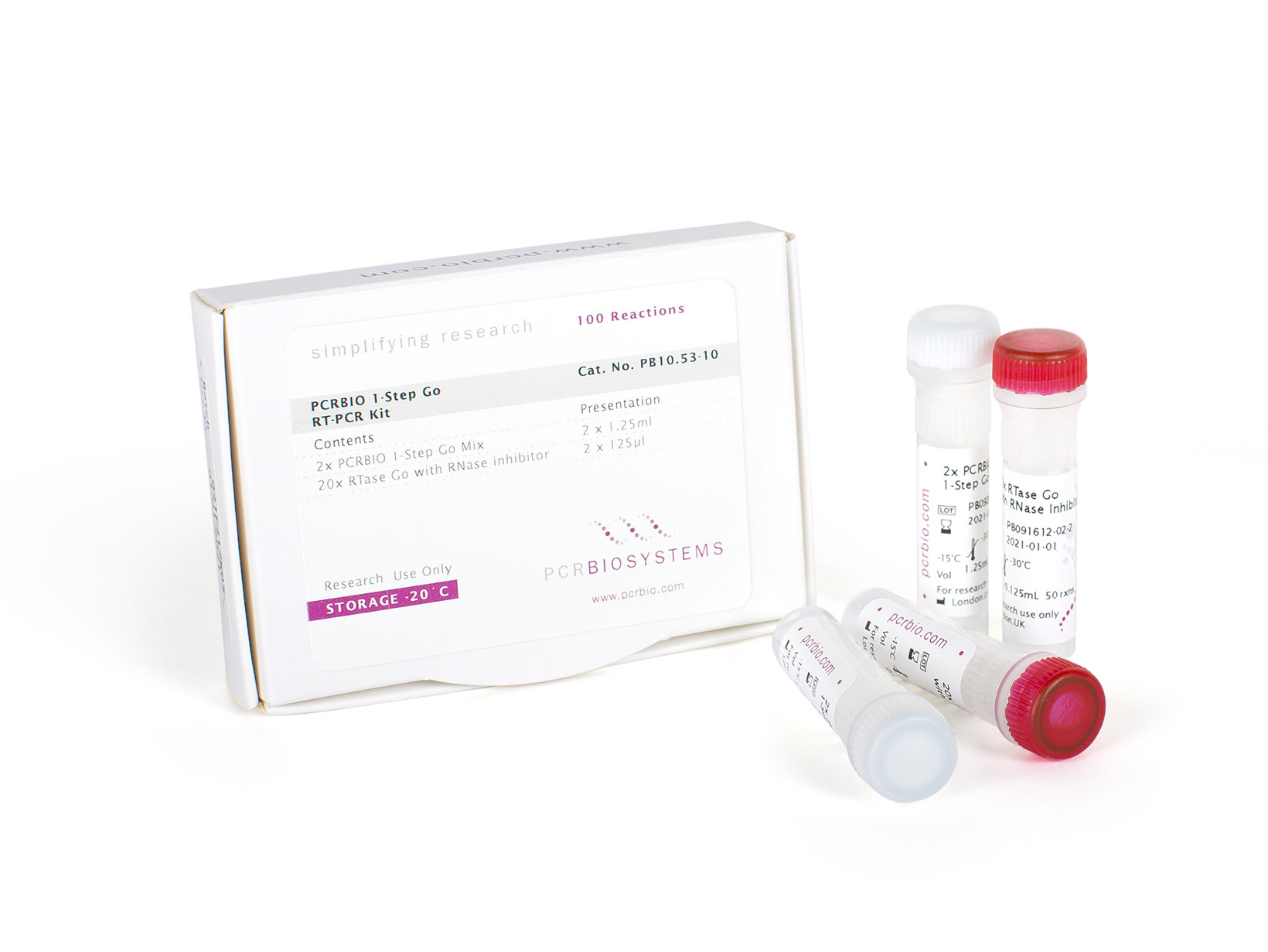
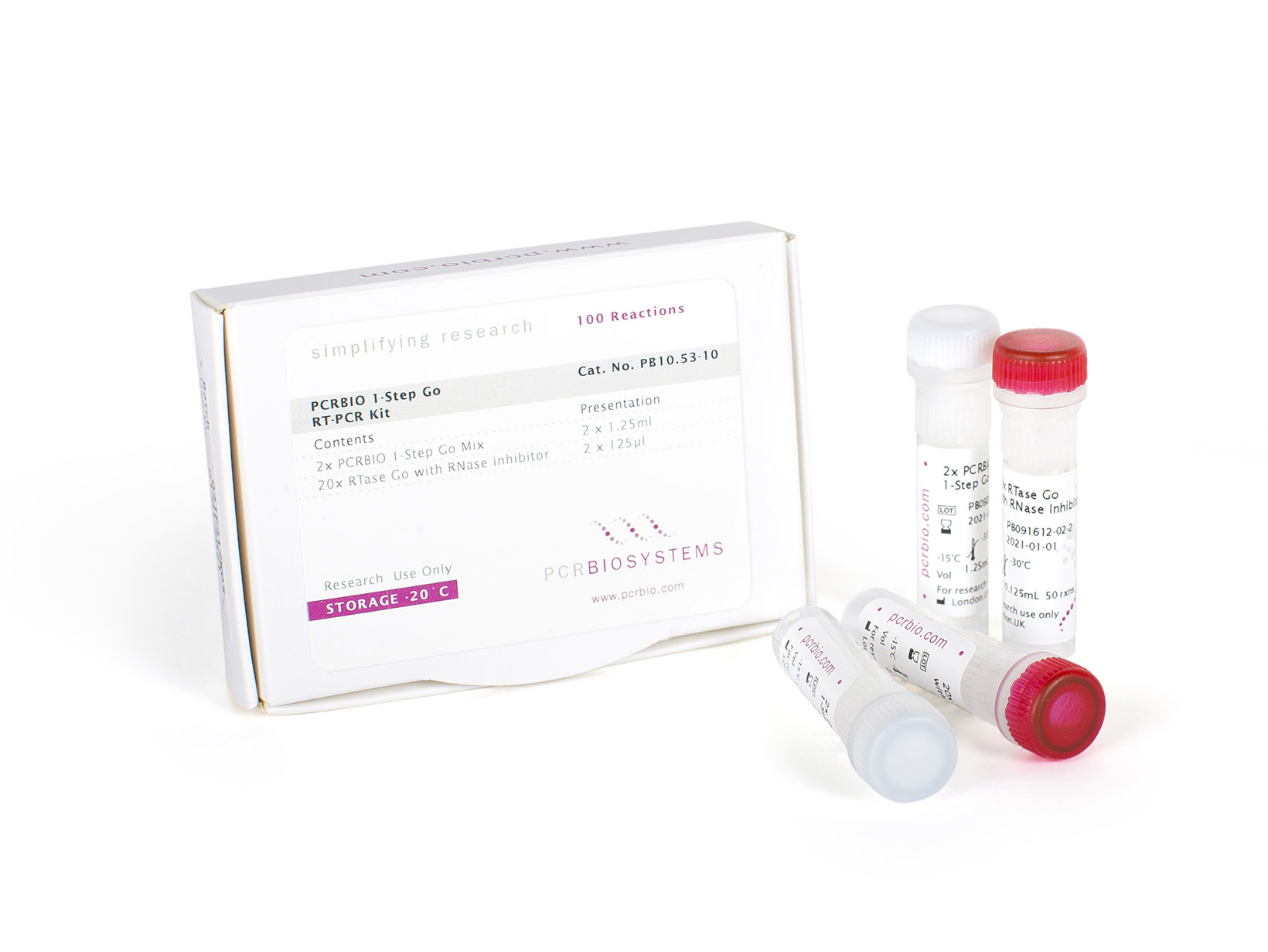
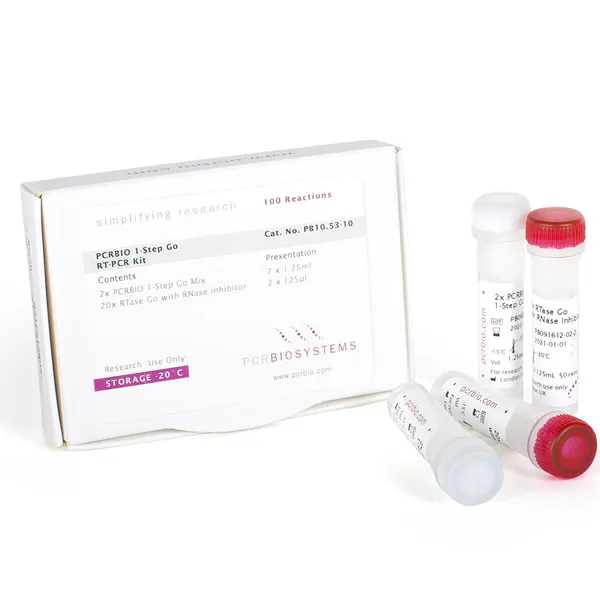
| PB10.53-05 | PCRBIO 1-Step Go RT-PCR Kit | 50 x 50 μL Reactions | Contact us |
| PB10.53-10 | PCRBIO 1-Step Go RT-PCR Kit | 100 x 50 μL Reactions | Contact us |
| PB10.53-50 | PCRBIO 1-Step Go RT-PCR Kit | 500 x 50 μL Reactions | Contact us |
| PB10.55-05 | PCRBIO 1-Step Go RT-PCR Kit Red | 50 x 50 μL Reactions | Contact us |
| PB10.55-10 | PCRBIO 1-Step Go RT-PCR Kit Red | 100 x 50 μL Reactions | Contact us |
| PB10.55-50 | PCRBIO 1-Step Go RT-PCR Kit Red | 500 x 50 μL Reactions | Contact us |
To view your price, please login or register with your quote reference.
Additional Information
What is the PCRBIO 1-Step Go RT-PCR Kit?
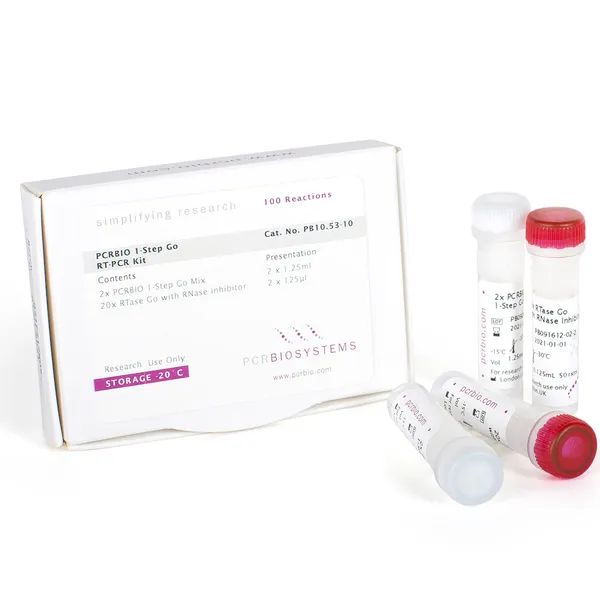
PCRBIO 1-Step Go RT-PCR Kit is a convenient, easy-to-use kit for rapid and efficient cDNA synthesis along with PCR in a single tube. The redesigned buffer system and modified reverse transcriptase enzyme provide enhanced performance and increased sensitivity.
The kit combines our modified thermostable reverse transcriptase enzyme (RTase Go) with an advanced RNase inhibitor to accelerate the speed and yield of cDNA synthesis. The PCR step is supported by PCRBIO HS Taq DNA Polymerase, delivering robust RT-PCR performance with minimal or no optimization required. Our antibody-mediated hot-start technology prevents primer dimer formation and nonspecific amplification, improving the sensitivity and specificity of the reaction compared to other methods.
PCRBIO 1-Step Go RT-PCR Kit can be used with any RNA template including mRNA, synthetic RNA, and viral RNA sequences, providing reliable detection even with the most challenging targets.
Now available in a red mix format for direct gel loading
In addition to the standard version, the kit is now available in a red mix format containing a red tracking dye, allowing direct PCR product loading onto agarose gel without the need for additional loading buffer. This simplifies downstream handling procedures, reduces pipetting steps, and minimizes contamination risk. It is ideal for large-scale or routine endpoint analysis.
The tracking dye migrates during electrophoresis and does not interfere with RT-PCR performance or product resolution. Both standard and red versions are designed for consistent setup, ease of use, and reliable results.
Applications
- Gene expression analysis
- Transcript analysis
- Gene cloning
- Multiplex RT-PCR
- Splice variant analysis
- RNAi research
Technical Specifications
PCRBIO 1-Step Go RT-PCR Kit
| Components | 50 Reactions | 100 Reactions | 500 Reactions |
|---|---|---|---|
| 20x RTase Go with RNase Inhibitor | 1 x 125 μL | 2 x 125 μL | 10 x 125 μL |
| 2x PCRBIO 1-Step Go Mix | 1 x 1.25 mL | 2 x 1.25 mL | 10 x 1.25 mL |
PCRBIO 1-Step Go RT-PCR Kit Red
| Components | 50 Reactions | 100 Reactions | 500 Reactions |
|---|---|---|---|
| 20x RTase Go with RNase Inhibitor | 1 x 125 μL | 2 x 125 μL | 10 x 125 μL |
| 2x PCRBIO 1-Step Go Mix Red | 1 x 1.25 mL | 2 x 1.25 mL | 10 x 1.25 mL |
Reaction Information
| Reaction Volume | Storage | |||
|---|---|---|---|---|
| 50 μL |
Upon receipt, the product should be stored between -30 to -20 °C. If stored properly, the kit will retain full activity until the expiration date indicated. |
Documents

Frequently Asked Questions (FAQs)
Can I change the activation time for the hot-start DNA polymerase enzyme?
We recommend using a minimum of 2 minutes to activate the enzyme. Longer times, up to 15 minutes, can also be used without adversely affecting the enzyme.
Do I need a one-step or two-step reaction?
One-step
Both cDNA synthesis and PCR occur in the same mix. This option is suitable for high-throughput applications due to its speed and ease of setup. It also reduces the risk of contamination. However, it is not ideal for poor quality RNA samples or if cDNA is required to be stored or analyzed separately.
Two-step
The cDNA synthesis and PCR reactions occur separately. This option is better suited if the cDNA product needs to be retained for analysis. It also allows for a higher level of reaction optimization. It permits control over the type and concentration of enzyme, RNA input, and cDNA concentration, leading to higher sensitivity compared to the one-step format.
Do I need to use an RNase inhibitor in my RT reaction?
No, RTase Go already contains an RNase inhibitor to prevent any breakdown and enhance sensitivity.
General troubleshooting for low product yield/late Ct values:
If you observe unusual late Ct values, try diluting the sample RNA. By doing this, you are diluting any inhibitors that may be present to concentrations where they do not inhibit the reaction. Additionally, try increasing the reverse transcription step to 55 °C and increasing the annealing/extension temperature. This can help resolve difficulties due to secondary structures present in the RNA samples and/or primers.
When inhibitor-related reaction inhibition is suspected, try reducing the sample amount1 or adding 0.4 – 4.4 mg/ml BSA to the reaction2.
To resolve more specific issues, please contact technical@pcrbio.com with the following information:
Amplicon size
Reaction setup
Cycling conditions
Screenshots of amplification plots and melt curves
1 Scipioni et al. A SYBR Green one-step real-time RT-PCR assay to detect human and bovine noroviruses and control for inhibition. Virology Journal.5:94 (2008). doi: 10.1186/1743-422X-5-94
2 Plante et al. The use of bovine serum albumin to enhance the detection of foodborne viruses washed from vegetable surfaces. Applied Microbiology. 52:3 (2010) doi: https://doi.org/10.1111/j.1472-765X.2010.02989.x
Is mRNA isolation necessary for sensitive RT-PCR?
mRNA isolation is usually not necessary. The PCRBIO 1-Step Go RT-PCR Kit has been developed to work on samples containing as little as 1 pg of total RNA or 0.01 pg of mRNA.
If working with rare mRNA species, use a primer specific to the sequence in the RT reaction to enhance sensitivity.
What primer strategies can I use?
Gene-specific primers can be used in the one-step reaction.
What amplicon size can I amplify?
The PCRBIO 1-Step Go RT-PCR Kit has been developed to amplify amplicons up to 3 kb from eukaryotic DNA.
What is the difference between the PCRBIO 1-Step Go RT-PCR Kit, qPCRBIO Probe 1-Step Go, and qPCRBIO SyGreen 1-Step Detect|Go?
The PCRBIO 1-Step Go RT-PCR Kit has been developed for endpoint RT-PCR. The qPCRBIO Probe 1-Step Go and qPCRBIO SyGreen 1-Step Detect|Go are probe-based and dye-based options for real-time RT-PCR, respectively.
Does this work for small RNA samples?
Yes, the PCRBIO 1-Step Go RT-PCR Kit can be used for small RNA samples. While we do not sell dedicated kits, all our RTases can be used for miRNA quantification and analysis.
We recommend using one of the following approaches:
- Use of a universal RT primer and the addition of a poly(A) or poly(U) tail (e.g., by poly(U)-polymerase), followed by cDNA synthesis using universal primers1,2.
- Use a gene-specific RT primer and skip the tailing step1,3-5.
If you are not familiar with the details of these approaches, please refer to the references listed below, which serve as guides.
1 Dave, V. P. et al. MicroRNA amplification and detection technologies: opportunities and challenges for point-of-care diagnostics. Lab Invest 99, 452-469, doi:10.1038/s41374-018-0143-3 (2019).
2 Mei, Q. et al. An easy and specific approach for real-time quantification of microRNAs using modified RT primers. PLoS One 7, e46890, doi:10.1371/journal.pone.0046890 (2012).
3 Chen, C. et al. Real-time quantification of microRNAs by stem–loop RT-PCR. Nucleic Acids Res 33, e179, doi:10.1093/nar/gni178 (2005).
4 Raymond, C. K., Roberts, B. S., Garrett-Engele, P., Lim, L. P. & Johnson, J. M. A simple, quantitative, PCR-based method for detecting low-level microRNAs. RNA 11, 1737-1744, doi:10.1261/rna.2148705 (2005).
5 Androvic, P., Valihrach, L., Elling, J., Sjoback, R. & Kubista, M. Two-tailed RT-qPCR: a novel method for highly accurate miRNA quantification. Nucleic Acids Res 45, e144, doi:10.1093/nar/gkx588 (2017).
Read more